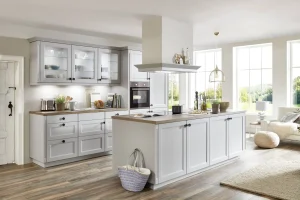
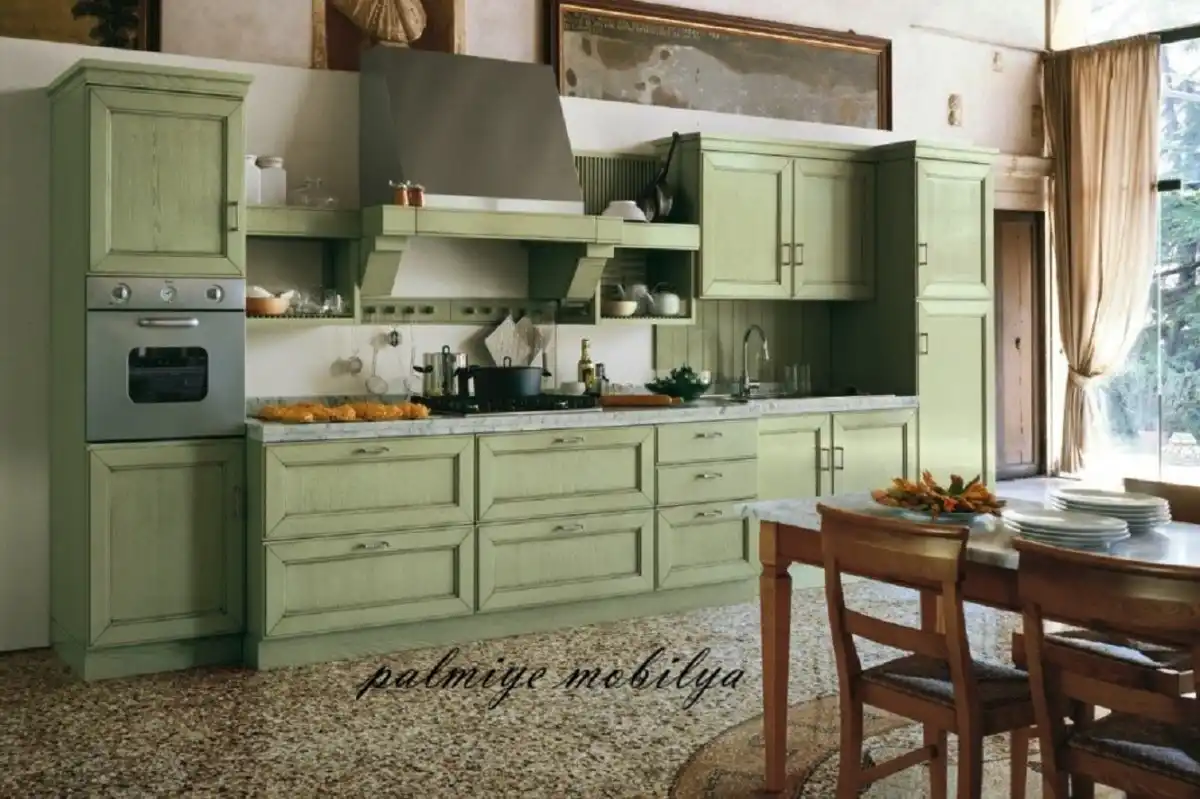
Country Kitchen Cabinet Turkey,
Country Kitchen Cabinet Turkey: The Definitive Technical Sourcing and Design Guide
The timeless charm of country-style kitchens remains unparalleled in modern residential architecture. Characterized by warm wood tones, ornate profiling, glass-fronted displays, and an inviting, artisanal atmosphere, the country kitchen serves as the emotional heart of the home. However, translating this classic aesthetic into a durable, precision-engineered manufacturing process requires deep technical knowledge.
Today, international property developers, interior architects, and wholesale furniture importers are increasingly turning to Turkey as their premier manufacturing hub for these specialized designs. Sourcing a Country Kitchen Cabinet Turkey means bridging the gap between centuries-old Mediterranean and Anatolian wood-carving traditions and cutting-edge European automated manufacturing technologies.
This comprehensive technical guide delivers an exhaustive, in-depth analysis of the engineering, material chemistry, design configurations, and supply-chain logistics defining the Turkish country kitchen cabinetry sector.
1. Architectural Principles of Country Kitchen Design
The layout philosophy of a country kitchen fundamentally differs from modern, ultra-minimalist spaces. While modern design prioritizes hidden, sterile surfaces, country kitchens embrace visible texture, layered architectural depths, and a sense of history. When engineering a Country Kitchen Cabinet Turkey, manufacturers focus on several core structural pillars to achieve this balance.
Decorative Crown Moldings and Cornices
The upper boundary of country cabinetry is defined by intricate architectural trim. Crown moldings serve as a decorative bridge between the top of the wall cabinets and the ceiling.
- Architectural Scale: Turkish manufacturers utilize advanced multi-axis CNC routers to carve deep, multi-tiered profiles into solid wood or high-density MDF. These moldings add vertical grandeur and prevent the cabinets from looking like basic, flat boxes.
- Light and Shadow Play: The specific stepped geometries of country cornices are engineered to catch ambient kitchen light, creating soft shadow lines that enhance the cozy, traditional feel of the space.
Recessed Shaker and Raised Center Panels
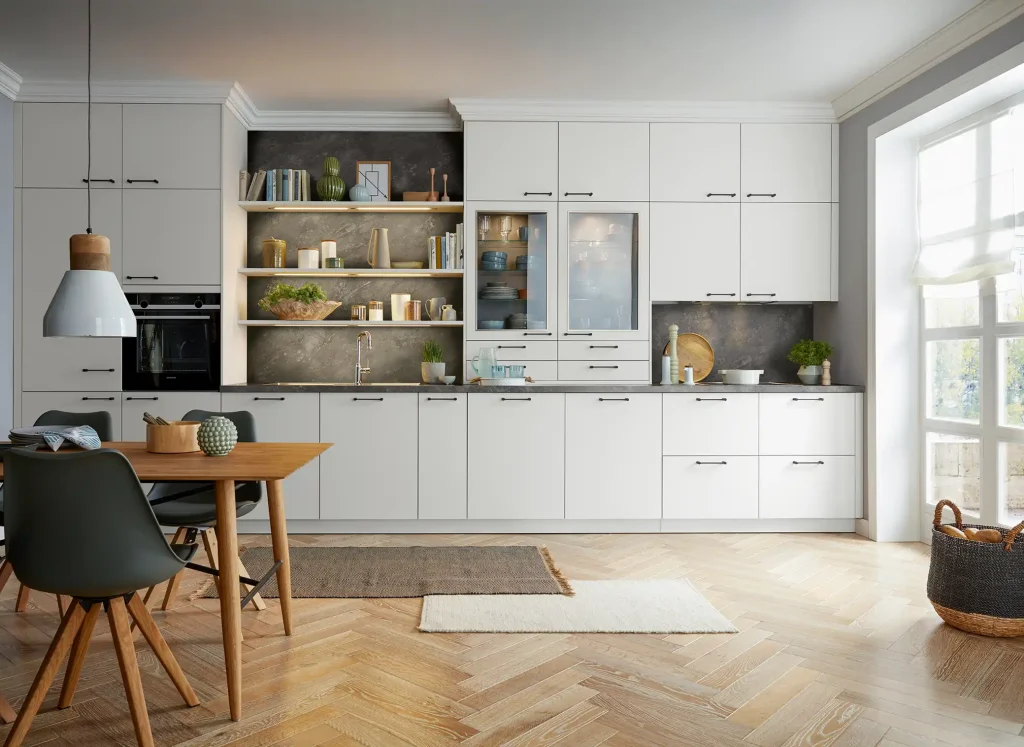
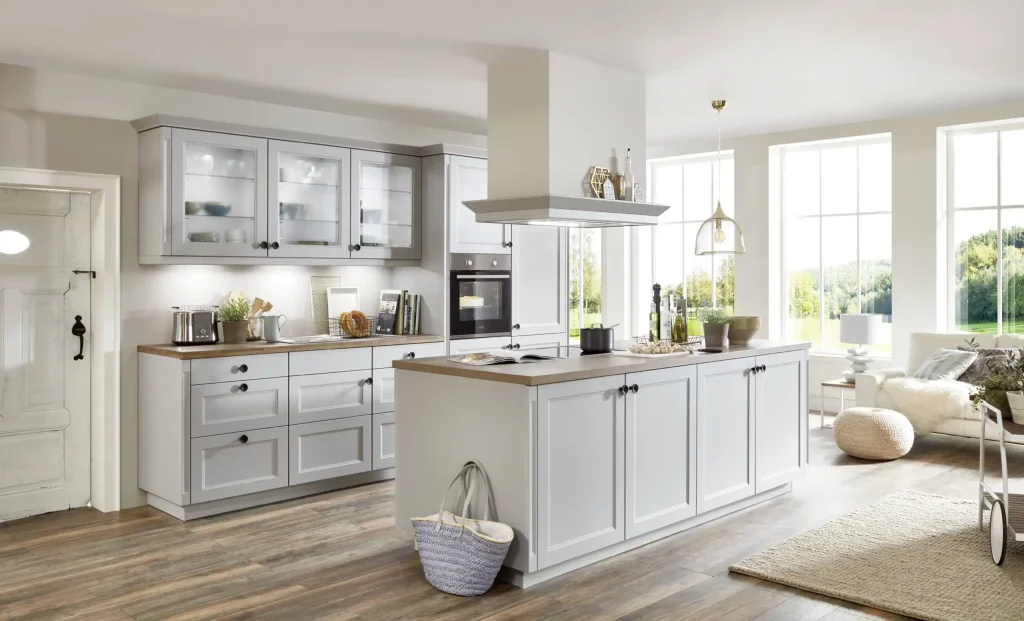
The defining feature of any country-style kitchen is the dimensional profile of its door faces. Flat slab doors are non-existent here; instead, two primary dimensional styles dominate the market:
- The Traditional Shaker Door: A classic five-piece construction featuring a flat center panel recessed behind a raised perimeter frame (typically 7 to 9 centimeters wide). It delivers a clean, geometric interpretation of country design.
- The Raised Center Panel Door: A more ornate configuration where the inner panel arches or slopes upward, flush with or slightly protruding from the outer frame. This style is heavily favored in classic farmhouse and Mediterranean rustic designs.
Open Shelving, Plate Racks, and Glass Display Modules
Country kitchens prioritize visual accessibility and warmth over complete concealment. High-end configurations incorporate specialized display modules directly into the cabinetry run:
- Integrated Plate Racks: Vertical wooden dowels spaced precisely 4 to 5 centimeters apart are built directly into upper open modules. This allows ceramic dinner plates to be stored vertically, functioning as both functional storage and a visual design asset.
- Mullion Glass Doors: Instead of a single solid pane of glass, country upper cabinets often feature wooden grids (mullions) that divide the glass face into multiple smaller window-like panes. This softens the reflection of light and adds an authentic, vintage touch.
2. Core Substrates and Structural Material Science
To the untrained eye, a country kitchen looks like it is made entirely of solid wood. However, from an engineering and longevity perspective, combining different advanced substrates creates a more stable, warp-resistant kitchen structure. The internal composition of a Country Kitchen Cabinet Turkey involves a careful balance of timber elements and composite wood panels.
Solid Wood Elements vs. High-Density MDF (Medium-Density Fiberboard)
- Solid Hardwoods (Oak, Walnut, Chestnut, Ash): In premium Turkish country cabinetry, solid wood is reserved for components that require intricate structural carving or are exposed to heavy structural stress. This includes door frames, decorative crown moldings, structural corbels, and visible kitchen island support pillars. Turkey’s rich forestry sectors in the Black Sea and Aegean regions provide abundant access to high-quality timber like robust European Oak and rich Anatolian Walnut.
- High-Density MDF (HD-MDF): For the large center panels of profiled doors, solid wood poses a structural risk. Wood is a living, hygroscopic material; it expands and contracts in response to changes in kitchen humidity caused by boiling water and cooking steam. If a large center panel is made of solid wood, it can warp, split, or crack over time. Turkish factories solve this by using premium HD-MDF for the center panels. HD-MDF is completely isotropic, dimensionally stable, and acts as a perfect canvas for intricate CNC profiling and smooth paint adhesion.
Carcass Engineering and Moisture Protection
The internal box of the cabinet (the carcass) must support heavy granite, quartz, or marble countertops.
- Melamine-Faced Chipboard (MFC): The baseline material for standard cabinet interiors. High-quality Turkish suppliers utilize 18mm thick, high-density MFC (as opposed to cheaper 16mm alternatives). This added thickness prevents shelf sagging under the weight of heavy cast-iron cookware.
- Moisture-Resistant (MR) Grades: Around the kitchen sink and dishwasher bay, standard panels are vulnerable to water ingress, which can cause swelling and structural failure. Turkish manufacturing centers adhere strictly to European EN 312 standards, deploying green-dyed moisture-resistant resins within the core substrate to guarantee a waterproof seal.
- Formaldehyde Emission Compliance (E1 & E0): Health and indoor air quality are critical metrics for search engine evaluation and consumer trust. All major Turkish panel manufacturers (such as Kastamonu Entegre and Yıldız Entegre) produce substrates that comply with or exceed the European E1 standard. For eco-conscious and luxury projects, ultra-low emission E0 panels are readily available, ensuring zero toxic VOC off-gassing into the domestic living environment.
3. Surface Finishing Techniques and Artisanal Patinas
The exterior finish of a country kitchen cabinet defines its visual character and protects the wood from grease, steam, and physical impacts. Unlike modern high-gloss kitchens, country cabinetry surfaces require multi-layered, tactile finishes that emphasize depth and age.
Polyurethane Lacquer and Matte Painted Finishes
For a clean, high-end farmhouse aesthetic, multi-coat lacquer painting is the preferred technical choice in Turkey.
- The Painting Protocol: The substrate undergoes automated calibration sanding, followed by the application of an isolation coat to seal the wood fibers. Next, two layers of high-build polyurethane primer are applied and meticulously sanded. Finally, two topcoats of premium polyurethane or acrylic matte lacquer are sprayed in computerized, dust-free cleanrooms.
- Durability Metrics: This multi-step process creates a completely monolithic, elastic paint skin over the profiled doors. It provides excellent resistance to chipping, yellowing under UV sun exposure, and chemical staining from household acidic liquids like lemon juice, vinegar, or red wine.
Patina, Distressing, and Glazing Processes
To give a Country Kitchen Cabinet Turkey an authentic, historic farmhouse appearance, skilled Turkish woodworkers apply manual finishing techniques that cannot be replicated by automated machines.
- Glazing: After the base paint coat is dry, a darker, semi-transparent glaze fluid is hand-wiped across the entire door panel. The artisan then wipes the surface clean, leaving the dark glaze trapped exclusively within the deep grooves, routed profiles, and corners of the Shaker frame. This accentuates the physical depth of the profile.
- Distressing and Antiquing: To simulate decades of natural wear, craftsmen use specialized tools to create subtle micro-indents, simulated woodworm tracks, or soft edge-sanding (where the underlying wood grain peeks subtly through the paint at natural friction points). The cabinet is then sealed with a dead-matte clear protective varnish.
Membrane (Thermofoil) for Budget-Conscious Formats
For volume buyers and multi-unit residential developments seeking a cost-effective country aesthetic, Turkish factories deploy advanced vacuum-press membrane lines.
- The Technology: A 3D-profiled MDF door panel is coated with a heat-activated polyurethane adhesive. A flexible polyvinyl chloride (PVC) foil, available in textured wood grains or matte pastel tones, is suspended over the panel. A massive industrial vacuum press combines high heat and vacuum pressure to fuse the foil seamlessly over the front and into every deep groove of the door profile.
- Performance: This eliminates front edge seams entirely, creating a highly durable, easily cleanable surface that is highly resistant to moisture penetration.
4. Hardware Engineering: Blending Vintage Styles with Modern Mechanics
A country kitchen should look historic on the outside, but it must operate with absolute modern mechanical precision on the inside. Sourcing a Country Kitchen Cabinet Turkey guarantees access to world-class internal hardware systems that optimize ergonomics within traditional cabinetry frames.
Soft-Close Motion Innovations
Turkish cabinetry integration heavily relies on premier European hardware components alongside high-performance domestic manufacturing giants like Samet.
- Heavy-Duty Concealed Hinges: Country doors are inherently heavy due to their solid frames or thick MDF profiles. Turkish suppliers spec 110-degree and 155-degree wide-angle clip hinges equipped with integrated hydraulic soft-close dampening. This ensures that even massive, heavy solid wood doors close silently with a gentle push, preventing frame damage over time.
- Tandembox Drawer Systems: Traditional country kitchens feature large drawer banks for pots and pans. Modern full-extension runner systems allow drawers to glide out entirely, exposing items at the very back. These systems support dynamic weight loads ranging from 30 kg to 70 kg per drawer without sagging or sticking.
Pull-Out Pantry and Corner Optimization Hardware
Traditional country layouts often include deep corner spaces or awkward architectural columns. Turkish interior engineers use specialized functional hardware to maximize these zones:
- The LeMans Corner System: Fluidly glides two kidney-shaped non-slip shelves completely outside the corner cabinet carcass, turning a dead structural corner into a highly accessible storage zone.
- Solid-Bottom Wire Pull-Out Larders: Installed in narrow 15cm to 30cm gaps next to traditional oven ranges, these pull-outs provide instant access to baking spices, oils, and condiments on heavy-duty, smooth-running tracks.
| Hardware Feature | Country Design Application | Technical Advantage |
|---|---|---|
| Heavy-Duty Soft-Close Hinges | Main cupboard doors | Prevents frame wear from heavy solid wood weights. |
| Full-Extension Tandem Drawers | Deep base drawer banks | Supports up to 70kg of heavy cast-iron cookware. |
| LeMans Corner Pull-Outs | L-shaped corner units | Reclaims dead corner volumes fluidly. |
| Integrated Soft-Close Damped Lifts | Upper glass mullion display cabinets | Allows upward-folding door access without hitting heads. |
Period-Accurate Exterior Pulls and Handles
The choice of exterior hardware acts as the “jewelry” of the country kitchen. Turkish manufacturers offer comprehensive catalogs of period-accurate handles, typically finished in:
- Antique Bronze and Copper: Finished with an artificial oil-rubbed patina that deepens over time.
- Wrought Iron: Provides a rugged, black matte, hand-forged texture ideal for rustic farmhouse or industrial country themes.
- Ceramic and Porcelain Knobs: Often hand-painted with subtle floral patterns or finished in crackled cream glazes, adding an authentic vintage layer to white or pastel-painted cabinets.
5. Color Psychologies and Textural Layering in Country Kitchens
Color choice defines the atmosphere of a kitchen space. While modern kitchens stick to monochromatic black, white, or gray, the country kitchen sector relies on complex, earthy tones that evoke nature, heritage, and warmth.
Farmhouse Cream, Off-White, and Alabaster
The quintessential country color palette centers on soft whites. Unlike stark modern clinical whites, farmhouse whites have warm yellow, beige, or subtle green undertones.
- Visual Expansion: These shades maximize natural light reflection, ensuring that even large country cabinets with heavy crown moldings do not make a kitchen feel claustrophobic or dark.
- Versatility: They provide an ideal backdrop for dark natural stone countertops, such as deep gray basalt or rich black Turkish granite.
Sage Green, Duck Egg Blue, and Pastel Earth Tones
In recent years, contemporary country designs have embraced muted colors inspired by nature.
- Sage Green: A major color trend in Turkish cabinet manufacturing. Sage green connects the interior space to the outdoors, evoking a peaceful, garden-fresh farmhouse feel. It pairs beautifully with natural oak accents and brass hardware.
- Duck Egg Blue and Navy Accents: Soft blues bring an elegant, coastal country feel to the home. Many designers use a two-tone layout, applying deep navy blue exclusively to a large central kitchen island while keeping the perimeter wall cabinets a soft cream or pastel gray.
Integrated Warm Timber Textures
An authentic country kitchen must feature visible wood grain. Turkish designers often blend painted cabinets with raw or stained wood elements:
- The Timber Accent Protocol: While the main wall and base cabinets might be painted in a matte linen white, specific focal points—such as the countertop of the kitchen island, an open plate-rack module, or the internal shelves of a glass display cabinet—are finished in a warm, stained natural oak or walnut grain. This architectural layering prevents the kitchen from looking flat or overly unified.
6. Sourcing and Wholesale B2B Procurement from Turkey
Turkey’s geopolitical position, combined with extensive capital investments in automated wood-processing infrastructure, has positioned the nation as a powerful alternative to both premium Italian workshops and high-volume East Asian factories. Understanding how to navigate the procurement landscape is essential for international buyers sourcing a Country Kitchen Cabinet Turkey.
The Main Woodworking and Furniture Clusters
The Turkish furniture ecosystem operates via specialized, geographically concentrated industrial zones:
- Bursa (İnegöl): The central hub of Turkey’s furniture exporting power. İnegöl contains massive industrial parks dedicated entirely to furniture manufacturing, wood processing, and hardware supply chains. Factories here range from specialized artisan shops executing ultra-luxury custom designs to fully automated plants producing high-volume cabinetry lines.
- Kayseri: The undisputed leader in high-volume, automated mass production. If a project requires thousands of standardized, flat-pack (RTA) country kitchen cabinets for a massive real estate development, Kayseri’s mega-factories deliver unmatched speed and cost efficiencies.
- Istanbul (Masko and Modoko): These are massive “furniture cities” located on the European and Asian sides of Istanbul, respectively. They act as premium design showcases. While the luxury showrooms cater to architects and high-end retail buyers, their direct manufacturing facilities operate in the outer industrial zones of the city.
- Ankara (Siteler): Historically famous for high-end solid wood carving and classic furniture craftsmanship. Siteler remains the preferred hub for intricate, highly customized country designs that require specialized hand-glazing, manual distressing, and custom solid-timber joinery.
Flat-Pack (RTA) vs. Rigid Factory-Assembled Configurations
When ordering from Turkish factories, international procurement managers must specify the structural delivery format based on logistics and local labor costs:
- Ready-to-Assemble (RTA / Flat-Pack): Cabinets are packed completely flat in heavy-duty cardboard boxes. Every panel is pre-drilled for cam-lock dowel fasteners, and all hardware is included in specialized kits. This format maximizes shipping container volume, significantly reducing international sea-freight costs. It is ideal for retailers and importers with access to efficient local installation teams.
- Rigid Factory-Assembled: The cabinet boxes are fully assembled, glued, and clamped under strict quality control directly on the factory floor before shipping. While this increases the shipping volume (requiring more containers), it drastically cuts down on-site installation labor costs and guarantees perfect factory alignment of complex country moldings and heavy doors.
Logistical Pathways and Trade Advantages
- Rapid Lead Times: While sourcing cabinetry from East Asian markets can take up to 60–90 days for production and maritime transit, Turkish factories typically execute production runs within 3 to 4 weeks.
- Geographical Connectivity: Utilizing overland trucking networks, shipments from Turkey can reach Central Europe within 3 to 5 days. Major deep-water ports like Ambarlı (Istanbul), Izmir, and Mersin provide reliable, fast sea-freight lanes to the United Kingdom, the Americas, North Africa, and the Middle East.
- Customs Union Integration: Turkey’s Customs Union agreement with the European Union enables duty-free movement of manufactured industrial goods via an A.TR certificate, offering an immediate financial and administrative advantage to European real estate developers and buyers.
7. Technical Material Performance Matrix
To guide procurement specifications, the following table outlines the comparative technical properties of the primary surface finishes used for country-style cabinetry manufactured in Turkey.
| Surface Finish Type | Scratch Resistance | Moisture Resistance | Suitability for Intricate CNC Carving | Cost Index | Primary Targeted Market Segments |
|---|---|---|---|---|---|
| Multi-Coat Polyurethane Lacquer | Medium-High | High (Seamless face protection) | Exceptional (Flows smoothly into deep grooves) | Premium | Luxury custom homes, high-end design boutique projects |
| Hand-Wiped Glazed & Antiqued Paint | High (Protective dead-matte topcoat) | High | Exceptional | Ultra-Premium | Bespoke luxury residences, heritage renovations |
| Membrane (3D PVC Vacuum Press) | High | Superior (Zero outer edge seams) | High (Requires smooth, radiused routing) | Mid-Range | High-volume residential housing developments, mass retail |
| Wood Veneer on HD-MDF | Medium (Requires care) | Medium-High (Requires protective seal) | Medium (Best for flat panels inside Shaker frames) | High | Authentic classic country homes, upscale natural designs |
8. Structural Engineering and Site Installation Protocols
The ultimate longevity of a premium country kitchen depends heavily on precision field installation. Because country cabinetry involves complex vertical layers—including heavy base units, tall pantry columns, upper display modules, and continuous interlocking crown moldings—the assembly process must follow strict structural rules.
Pre-Installation Structural Assessment
- Wall Load Capacity: Country wall cabinets are inherently heavy due to their solid wood frames, thick door panels, and internal glass shelves. Installers must verify the composition of the structural walls. Brick, concrete, or stone walls require heavy-duty expanding nylon wall anchors. If mounting onto drywall (gypsum board) systems, the installation team must locate internal steel or timber studs, or install a solid plywood horizontal tracking rail behind the drywall before hanging modules.
- Laser Alignment and Leveling: Traditional country properties often feature sloped floors or uneven walls. Installers must deploy multi-axis laser levels to project a true horizontal datum line across the kitchen footprint. Any variation in the floor must be absorbed by adjusting the heavy-duty ABS plastic legs beneath the base cabinets, ensuring the final countertop slab rests on a perfectly level plane.
The Crown Molding and Cornice Interlocking Sequence
Installing a continuous run of ornate country crown molding requires precise carpentry joinery:
- Carcass Alignment: Upper cabinets must be perfectly aligned, clamped together, and locked with binding sleeves so that their top faces form a single continuous surface.
- Compound Miter Cutting: At the corners where the cabinetry line turns 90 degrees, the crown molding cannot simply be butt-joined. Installers use high-precision miter saws to execute compound cuts (simultaneously cutting the profile at a horizontal 45-degree angle and a specific vertical tilt angle).
- Banding and Fastening: The mitered corners are joined using specialized wood epoxies and pinned from behind using pneumatic brad nailers, creating an invisible, seamless architectural transition line that does not split under temperature fluctuations.
  [Wall Substrate] ---> Continuous Galvanized Hanging Rail (Bolted into Studs)
                                       |
                                       v (Secure Hooking)
  [Cabinet Upper Box] <--- 3D Adjustable Hanging Bracket (Internal Tension Tuning)
                                       |
                                       +---> [Top Face Frame] ---> Compound Mitered Crown Molding
Waterproof Sealing at the Backsplash and Apron Sink Junctions
Country kitchens frequently incorporate large, heavy ceramic farmhouse apron-front sinks. These sinks sit exposed through a custom cutout in the base cabinetry line.
- Structural Support Cradle: Because a ceramic apron sink filled with water can exceed 80 kg, installers build a heavy-duty internal structural timber cradle inside the base cabinet carcass to support the weight directly from the subfloor, preventing any structural load from resting on the cabinet walls.
- Polyurethane Sealants: Every joint line where the ceramic sink meets the wood cabinetry face or the quartz countertop must be sealed with high-grade, anti-fungal polyurethane or structural silicone sealant. This prevents water from running behind the face frames, protecting the internal engineered panels from moisture over time.
9. Strategic Financial Budgeting and Cost Optimization
Procuring a high-end country kitchen involves multiple material and layout variables. Real estate developers and homeowners can optimize budgets by understanding where to allocate funds for maximum impact and where to save without compromising the overall country aesthetic.
Strategic Premium Investments (Do Not Compromise Here)
- The External Face Paint (Lacquer Quality): The visual identity of a country kitchen depends entirely on its surface finish. Cutting costs by using low-grade, single-coat paints will result in yellowing, peeling, and chipping within a few years. Always invest in premium, multi-layer polyurethane or acrylic painted finishes.
- High-Stress Drawer Mechanisms: Country kitchens rely heavily on deep drawer banks to store heavy ceramic dishware and iron pots. Investing in premium soft-close runners with high weight ratings (such as 50kg or 70kg full-extension tracks) ensures smooth operation for decades.
- The Structural Corner Solutions: Do not install cheap, static shelves inside an L-shaped corner cabinet. The deep corner volume becomes completely useless. Spending extra on an advanced mechanical pull-out system like a LeMans unit ensures every square centimeter of space is highly functional.
Smart Cost-Reduction Strategies
- Selective Solid Wood Deployment: You do not need the entire cabinet carcass or internal shelves to be solid oak or walnut. Specifying high-density, melamine-faced chipboard (MFC) or standard MDF for the interior cabinet boxes is completely hidden from view, saving significant material costs while maintaining a rock-solid structure. Save the budget for solid wood exclusively on visible elements like door frames and crown moldings.
- Standardized Modular Configurations: Custom engineering one-off cabinet dimensions requires manual design interventions and custom factory machine programming. By planning your kitchen layout around standard factory widths (such as 30, 45, 60, and 90 cm modules), you take full advantage of automated mass-production pricing. Use affordable, matching filler panels at the wall ends to cleanly absorb any remaining odd centimeters.
- Optimized Glass Mullion Modules: Having every single upper cabinet door feature custom glass and intricate mullion woodwork increases costs. Instead, strategically position just two glass display modules as central focal points (for example, flanking the extraction hood), and keep the remaining perimeter upper doors as solid Shaker panels. This creates an elegant visual balance while significantly reducing production expenses.
10. Long-Term Maintenance and Structural Longevity Protocols
Preserving the rich textures, intricate profiles, and precise mechanical alignment of a country kitchen requires consistent, specialized maintenance protocols, particularly in environments exposed to cooking heat, oils, and fluctuating humidity.
Specialized Cleaning Protocols for Painted and Glazed Profiles
- Routine Dust and Grease Removal: The deep grooves of Shaker frames and the intricate curves of crown moldings naturally collect airborne cooking grease and dust. Surfaces should be cleaned weekly using a soft, damp microfiber cloth dipped in warm water mixed with a neutral, pH-balanced liquid soap. Never use abrasive scouring pads, steel wool, or harsh chemical bleaching agents, which can dull or scratch the protective matte lacquer topcoat.
- Deep Cleaning Details: For the tight corners of routed door profiles where grease can settle, use a soft-bristled tooth or detailing brush dipped in a mild soapy solution to gently dislodge buildup without scratching the finish. Wipe the area dry immediately with a clean microfiber towel to prevent water from pooling in the grooves.
Managing Internal Kitchen Micro-Climates
- Extraction Hood Ventilation: Country kitchens generate significant steam from large family pots and ovens. It is critical to run an efficient extraction hood with an adequate volumetric air exchange rate (\(m^3/h\)) whenever cooking. This prevents moisture from condensing on the underside of upper decorative cornices and open wood plate racks, protecting the timber from swelling or warping.
- Dishwasher Steam Mitigation: When a dishwasher finishes its cycle, it vents localized, high-temperature steam. To protect the surrounding country face frames and doors from heat and moisture stress, ensure a metallic or specialized plastic steam deflector strip is mounted on the underside of the countertop directly above the dishwasher opening. Keep the dishwasher door firmly closed until its internal temperature cools down completely.
Sourcing Documentations, Warranties, and Quality Compliance
When establishing a B2B supply contract or making an individual investment in a Country Kitchen Cabinet Turkey, ensure the manufacturer provides comprehensive compliance certifications to guarantee safety and long-term product accountability:
- ISO 9001 & ISO 14001: Validates that the factory operates under strict, globally audited quality and environmental management standards.
- TSE Certification: Issued by the Turkish Standards Institution, confirming the cabinetry meets all national performance, physical safety, and material durability baselines.
- CE Marking & European Conformity: Essential for smooth customs clearance and regulatory alignment within European Union markets.
- Warranty Structural Terms: Reputable Turkish cabinetry exporters provide structured warranties ranging from 2 to 5 years. This warranty should explicitly cover structural carcass delamination, door warpage exceeding acceptable tolerances (typically \(\pm 2\)mm), and factory hardware mechanical failures.
Conclusion: Sourcing Timeless Artisanal Elegance from Turkey
The international demand for Country Kitchen Cabinet Turkey highlights a successful fusion of classic aesthetic charm, traditional woodwork mastery, and advanced engineering technologies. By utilizing stable HD-MDF core substrates for profiled doors, applying multi-layered protective matte lacquers with manual glazing patinas, and integrating heavy-duty European soft-close mechanics, Turkish manufacturers construct elegant, high-capacity country kitchens tailored for sophisticated modern living.
By closely following the material science criteria, structural installation sequences, and cost-optimization strategies detailed in this guide, property developers, architects, and homeowners can design inviting country spaces that serve as enduring pillars of structural quality and architectural beauty for decades to come.

Şunları da sevebilirsiniz
Lacquered Room Doors Production Turkey
Solid Wood Door Turkey